Building a heart: Realheart aims to create new opportunities for patients with heart failure
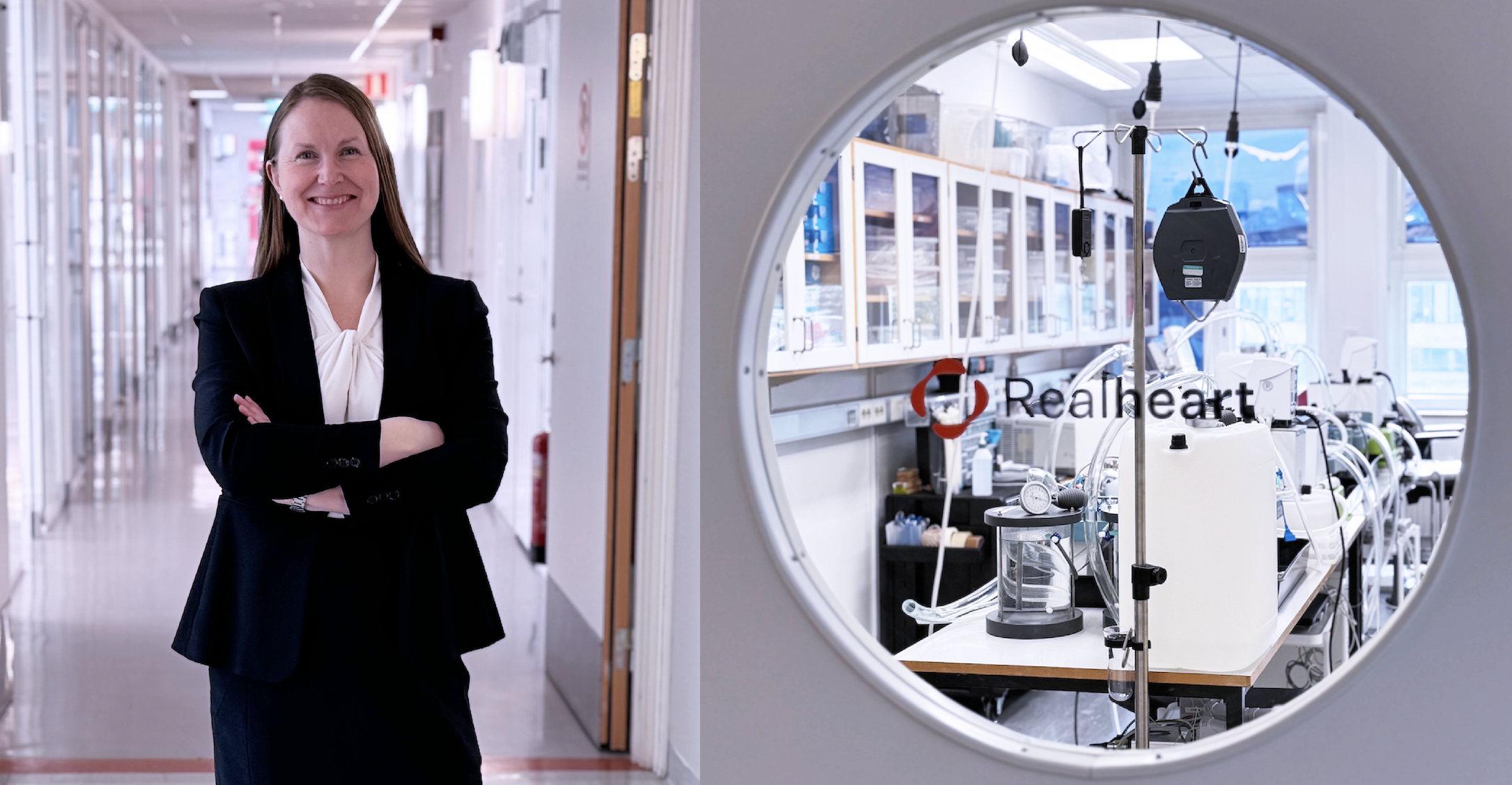
A mechanical heart, as close to a human heart as it gets. Realheart is the company developing a total artificial heart for patients with advanced heart failure, a condition where treatment options are often limited. When we sit down with CEO Ina Laura Perkins, she tells the story of an innovation that has taken its time, about the strong drive to reach all the way to patients, and about steps that are bringing the company closer to clinical reality.
It has two atria, two ventricles, and pumps blood just like the human heart – through a mechanism known as atrioventricular plane displacement (AVPD). Realheart TAH® is the total artificial heart designed not only to replicate the heart’s anatomy, but also to mimic its function. Within a few years, it could be supporting patients with heart failure while they await transplant. In the longer term, it is intended to serve as a replacement for the human heart itself, when needed. The device is assembled at the company’s headquarters in Västerås, and Realheart’s blood laboratory is located in Flemingsberg.
The road to Realheart
When we meet CEO Ina Laura Perkins, she explains that Realheart was founded in 2007, but that the story begins much earlier, in Iraqi Kurdistan. This is where founder Azad Najar was born, who as a child grew up with a cousin who suffered from heart disease, and saw the impact it had on his everyday life and childhood. A strong impression that followed him throughout life, in his profession as a doctor, and later all the way to Sweden where to he moved as a result of the war in his home country.
In addition to his full-time job as a urologist, and with a strong interest in technology, he began spending evenings, nights and weekends in the basement of his home in Västerås in 1999, developing a solution for replacing a failing heart with a new one. His starting point was simple: to create a solution that would be as natural and functional as possible for patients.
– Artificial hearts have been around since the 80’s and he watched documentaries about it and thought: evolution has developed the human heart for a reason and it must be the best, so that’s what we should start with. So, when he saw these documentaries, he wondered: why don’t they look like the human heart?
It went from a first prototype made of balloons and tape to a slightly more developed one that impressed Swedish doctors. A few years later, the first real version that could pump blood was ready, and around the same time Realheart was listed on the stock exchange.
The blood lab that strengthens patient safety
When Ina Laura Perkins joins in 2017, she comes in with a background as a blood researcher, and experience in developing heart pumps in particular. She sees an opportunity to take steps forward through academic collaborations, and by testing the innovation with human blood. Something she points out as a crucial success factor, and where the opportunities to do so in Sweden are unique compared to the rest of the world. This results in a collaboration with Karolinska Institute, and the start of a blood lab in the Blood Center at Karolinska University Hospital in Flemingsberg.
Two years ago, they moved the lab to Novum Labs, the co-working space in Novum Research Park just a stone’s throw away. Here, biomedical engineer Faisal Zaman and lab technician Marianne Lindberg work to test how the human blood is affected. A rigorous method with extensive regulations to ensure patient safety, where the focus is on ensuring that it can circulate through the artificial heart without being damaged or causing complications such as blood clots, strokes or other blood damage.
– We can risk mitigate in a better way since we test with the same species’ blood that the device is designed for – human, not animal blood.
Lab technician Marianne Lindberg and biomedical engineer Faisal Zaman work at the blood laboratory in Flemingsberg.
Steps towards clinical reality
For an artificial heart to be approved, it must pass several crucial tests: that it lasts long enough, that it can pump blood in a living body, and that the blood is not damaged to an excessive extent. Ina Laura describes that Realheart is making good progress across all of them. Right now, they’re working on preclinical studies in collaboration with Sahlgrenska University Hospital, which will also be a partner in clinical studies going forward. At the same time, they have also been granted several patents for their control system, including in India, the EU, and most recently in Australia. At the headquarters in Västerås, engineers work in system development, mechanics, testing and production. They also recently moved into larger premises to be able to manufacture the pumps required for future studies in patients.
– Now we know that the pump works and we have had such great results. So now it is about scaling up production and improving quality to be able to move towards human trials.
Within the next five years, Ina Laura Perkins says that clinical trials will be underway and that Realheart TAH will be evaluated as a bridge-to-transplant solutions for patients awaiting a heart transplant.
– Although our ultimate goal is to provide a replacement for the human heart and an alternative to transplantation, our first indication is to bridge patients so that they live long enough to receive their donor heart.
Community and the drive forward
Ina Laura Perkins speaks warmly about the collaborations and community in Flemingsberg. She divides her time between both offices, but Novum Research Park in particular happens to be extra familiar, and a bit like home. After studying biomedicine at Karolinska Institute, she worked many summers in the building where Realheart now has its blood lab.
– The first big word is community. Here, it feels like coming home, that you enter a community where everyone works on different things but often share similar challenges. Here you can brainstorm ideas about both financing and business plans in the corridors.
When we ask what drives her forward as a CEO, the answer comes fast as lightning.
– There is such a great need, and you can make such a big difference with a heart pump. We haven’t reached the potential of this yet. There is so much more to do, so much more to achieve, so many patients who are dying, in my opinion completely unnecessarily. We can help, we just haven’t reached the point yet where we can help everyone.